
Common Reasons Your Plant Has Stopped Growing and How to Fix It
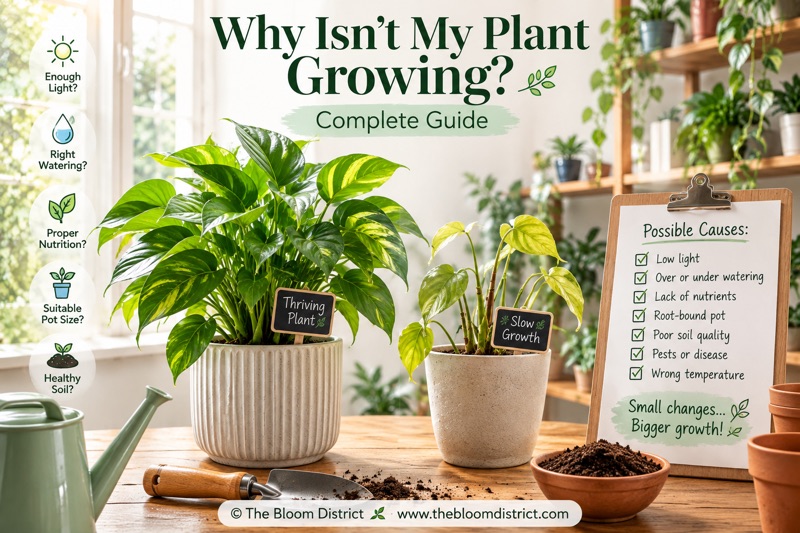
🌱 Introduction: When Your Plant Seems Stuck
There is something magical about watching a tiny leaf slowly unfold into a beautiful green plant. We water it, place it near a window, and patiently wait for new growth.
But sometimes… nothing happens.
Weeks pass. The plant looks alive but refuses to grow. No new leaves, no taller stems, no visible changes.
Before assuming your plant is unhealthy, remember this:
A plant that stops growing is usually trying to tell you something.
Slow growth is often a sign that one of its basic needs is not being met — light, water, nutrients, roots, temperature, or even the season.
In this guide, we will uncover the hidden reasons behind slow plant growth and discover how to help your green companion thrive again.
🌿 Plant Growth at a Glance
|
Problem |
What You Notice |
Possible Cause |
Solution |
|
No new leaves |
Plant stays the same size |
Not enough light |
Move to brighter location |
|
Yellow leaves |
Leaves lose color |
Overwatering or nutrient issues |
Adjust watering and soil |
|
Small weak growth |
Thin stems |
Lack of nutrients |
Add suitable fertilizer |
|
Roots filling the pot |
Water dries quickly |
Root bound plant |
Repot into a larger container |
|
Drooping plant |
Leaves look tired |
Water stress |
Check soil moisture |
🌱 1. Your Plant Is Not Getting Enough Light
Light is the energy source that allows plants to create food through photosynthesis.
Even plants described as “low-light plants” still need some amount of light to grow.
A plant placed in a dark corner may survive, but survival is different from healthy growth.
Signs of insufficient light:
✓ Long, weak stems
✓ Small new leaves
✓ Leaves turning toward the window
✓ Slow or stopped growth
✓ Pale green color
How to fix it:
- Move the plant closer to a bright window.
- Rotate the pot every few days for balanced growth.
- Use a grow light if natural sunlight is limited.
Bloom District Tip 🌿
A plant can stay alive in poor light, but it rarely reaches its full beauty.
☀️ 2. Incorrect Watering Habits
One of the biggest reasons plants stop growing is improper watering.
Both overwatering and underwatering can slow growth.
Overwatering symptoms:
- Yellowing leaves
- Soft stems
- Wet soil for many days
- Root problems
Underwatering symptoms:
- Dry crispy leaves
- Drooping
- Slow leaf production
- Soil pulling away from the pot edges
The best watering method:
Instead of following a strict schedule:
Check the soil first.
Insert your finger 2–5 cm into the soil:
- Dry → Water your plant
- Moist → Wait a little longer
🌱 3. Poor Soil Quality Is Limiting Growth
Healthy roots need healthy soil.
Old or poor-quality soil can become compacted, preventing roots from receiving:
- Oxygen
- Water balance
- Nutrients
Signs your soil needs attention:
✓ Water sits on the surface
✓ Soil becomes hard like a block
✓ Roots appear above the soil
✓ Plant growth becomes slower each season
Ideal soil should provide:
|
Soil Feature |
Why It Matters |
|
Good drainage |
Prevents root damage |
|
Air spaces |
Helps roots breathe |
|
Organic matter |
Provides nutrients |
|
Proper texture |
Supports healthy roots |
🌿 4. Your Plant May Need More Nutrients
Plants use nutrients to produce:
- New leaves
- Strong stems
- Healthy roots
- Flowers
Over time, nutrients in the soil become depleted.
Common nutrient deficiencies:
|
Nutrient |
Symptoms |
|
Nitrogen |
Pale leaves and weak growth |
|
Phosphorus |
Slow development |
|
Potassium |
Weak stems and leaf problems |
Solution:
Use a balanced fertilizer during the growing season.
Avoid adding too much fertilizer — more is not always better.
Too much fertilizer can burn roots and create a new problem instead of solving one.
🌱 5. The Pot Size May Be Wrong
Sometimes your plant is ready for a bigger home.
A plant growing in a container that is too small can become root bound.
Signs your plant needs repotting:
- Roots growing from drainage holes
- Soil dries extremely quickly
- Growth has stopped suddenly
- Roots circle tightly around the pot
Repotting tips:
Choose a pot:
✓ Only 2–5 cm larger than the previous one
✓ With drainage holes
✓ Filled with fresh suitable soil
A much larger pot can hold excess water and increase root problems.
🌱 6. Temperature Stress Can Slow Plant Growth
Plants are living organisms, and just like humans, they have preferred environments.
When temperatures become too hot or too cold, many plants slow down their growth to protect themselves.
Signs of temperature stress:
✓ New leaves appear very slowly
✓ Leaves curl or droop
✓ Growth stops during extreme weather
✓ Leaves develop brown edges
Common causes:
- Placing plants near air conditioners
- Cold drafts from windows
- Sudden temperature changes
- Excessive heat near glass windows
How to fix it:
🌿 Keep indoor plants away from direct air vents.
🌿 Avoid moving plants suddenly between very different environments.
🌿 Maintain a stable temperature whenever possible.
Bloom District Tip 🌿
A happy plant prefers consistency more than perfection.
🍂 7. Your Plant May Be in a Natural Rest Period
Sometimes your plant is not struggling — it is simply resting.
Many plants naturally slow down during:
- Winter months
- Extremely hot seasons
- Low-light periods
During dormancy, plants use their energy to maintain themselves instead of producing new growth.
During this period:
✓ Reduce fertilizing
✓ Avoid unnecessary repotting
✓ Water less frequently if soil stays moist longer
✓ Be patient
When conditions improve, healthy growth usually returns.
🐛 8. Pests Can Steal Your Plant’s Energy
Tiny pests can quietly damage your plant before you notice obvious symptoms.
Common pests include:
- Spider mites
- Fungus gnats
- Aphids
- Scale insects
- Mealybugs
These pests feed on plant tissues and reduce the energy available for growth.
Warning signs:
|
Symptom |
Possible Pest |
|
Tiny webs under leaves |
Spider mites |
|
Sticky leaves |
Aphids or scale |
|
Small flying insects near soil |
Fungus gnats |
|
White cotton-like spots |
Mealybugs |
Natural pest prevention:
🌿 Clean leaves regularly
🌿 Inspect new plants before bringing them home
🌿 Remove affected leaves
🌿 Use gentle natural treatments when needed
✂️ 9. Incorrect Pruning Can Delay Growth
Pruning can encourage healthier growth, but cutting too much can stress your plant.
Some beginners remove healthy leaves thinking it will help the plant grow faster.
However, leaves are the plant’s energy factories.
Removing too many leaves can reduce its ability to produce energy.
Better pruning habits:
✓ Remove only damaged or dead leaves
✓ Use clean, sharp tools
✓ Research your plant’s pruning needs
✓ Prune during active growing seasons
🌱 10. Your Plant Simply Needs More Time
One of the biggest gardening lessons is patience.
Not all plants grow at the same speed.
Some plants naturally grow quickly:
🌿 Pothos
🌿 Spider plants
🌿 Herbs
Others grow slowly:
🌵 Cacti
🌳 Some trees
🌿 Certain tropical plants
A slow-growing plant is not always an unhealthy plant.
Sometimes it is simply following its natural rhythm.
🌿 Plant Growth Diagnosis Guide
What does your plant look like?
|
Your Plant’s Condition |
Most Likely Reason |
|
Healthy but no new leaves |
Not enough light or natural slow growth |
|
New leaves are tiny |
Nutrient or light problem |
|
Leaves are yellow |
Watering issue |
|
Stems are long and weak |
Searching for light |
|
Growth stopped suddenly |
Stress, pests, or root problems |
|
Plant looks crowded |
Needs repotting |
🌱 A Simple 7-Day Plant Recovery Plan
If your plant has stopped growing, try this gentle reset:
Day 1: Observe
Look carefully at:
✓ Leaves
✓ Soil moisture
✓ Roots
✓ Location
Do not change everything at once.
Day 2–3: Improve Light
Move your plant to a brighter location if needed.
Remember:
More light = more energy for growth.
Day 4: Check Watering
Adjust your watering routine based on the soil, not a calendar.
Day 5: Clean and Inspect
Remove:
- Dust from leaves
- Dead leaves
- Visible pests
Clean leaves help plants absorb light better.
Day 6: Check Soil and Roots
Look for:
- Poor drainage
- Root crowding
- Compact soil
Day 7: Create a Care Routine
Healthy plants grow best with consistent care.
Choose a simple routine:
🌿 Weekly leaf check
🌿 Monthly soil check
🌿 Seasonal fertilizing
🌿 Common Mistakes That Stop Plant Growth
❌ Mistake 1: Changing Locations Too Often
Constant movement can stress plants.
❌ Mistake 2: Overwatering Because Growth Is Slow
More water does not mean faster growth.
❌ Mistake 3: Fertilizing Too Much
Excess nutrients can damage roots.
❌ Mistake 4: Ignoring Root Health
Healthy roots create healthy plants.
❌ Mistake 5: Expecting Immediate Results
Plants grow slowly — but they grow with the right conditions.
🌱 Frequently Asked Questions (FAQ)
Why is my plant alive but not growing?
A plant can survive with limited resources but may stop growing when it lacks enough light, nutrients, or suitable conditions.
How long does it take for a plant to grow new leaves?
It depends on the plant type and environment. Some plants produce new leaves within weeks, while others may take months.
Should I fertilize a plant that is not growing?
Only if the plant is actively growing and the soil may lack nutrients. Fix light and watering problems first.
Does talking to plants help them grow?
While there is no strong scientific evidence that talking directly makes plants grow faster, caring for plants regularly helps you notice their needs earlier.
🌿 Quick Summary
|
Problem |
Solution |
|
Lack of light |
Move to brighter area |
|
Incorrect watering |
Check soil before watering |
|
Poor soil |
Refresh soil or improve drainage |
|
Lack of nutrients |
Use suitable fertilizer |
|
Small pot |
Repot carefully |
|
Temperature stress |
Provide stable conditions |
|
Pests |
Inspect and treat early |
|
Slow natural growth |
Be patient |
🌱 Final Thoughts From The Bloom District 🌿
A plant that is not growing is not always failing.
Sometimes it is asking for a small change:
A little more sunlight.
A healthier soil mix.
A better watering habit.
Or simply more time.
Gardening is a relationship built on observation and patience. When you learn to understand your plant’s signals, you are not just growing plants — you are creating a healthier, greener space around you.
Related Articles
Comments
Post a Comment