
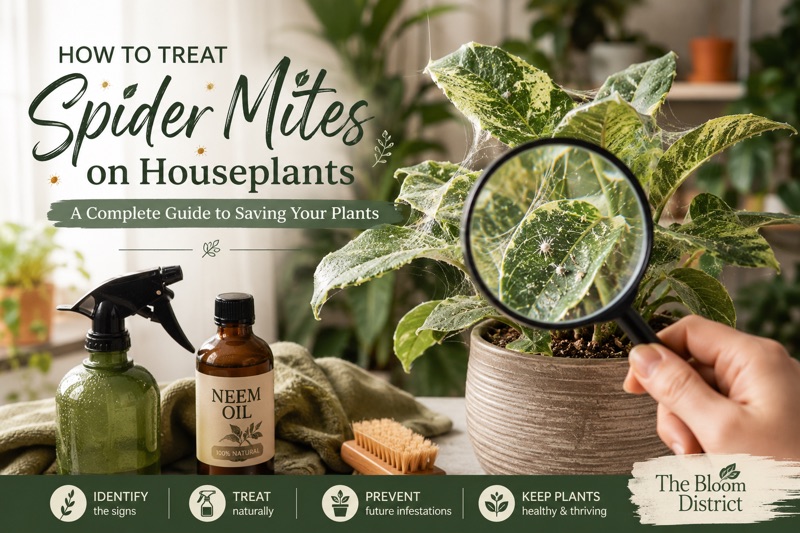
The Tiny Enemy Hiding Beneath Your Leaves 🕷️🌱
You walk past your favorite houseplant and notice something feels different.
The leaves that were once bright and healthy now look tired.
The beautiful green color has faded.
Small yellow specks have appeared across the surface.
You touch the leaves, searching for the problem.
Then you see it…
A delicate web stretching between the stems.
Not a spider.
Not dust.
A hidden invasion.
Spider mites.
These microscopic pests are among the most common enemies of indoor plants. They are almost invisible at first, but they can quickly transform a thriving plant into a weak, stressed, and struggling one.
The good news?
Your plant is not lost.
With early detection, the right treatment, and a little patience, you can restore your indoor garden and help your plants grow beautifully again.
Welcome to your complete Spider Mite Rescue Guide by The Bloom District 🌿
Quick Plant Rescue Summary 🌱
|
Problem |
Spider Mite Infestation |
|
Pest Type |
Tiny spider-like plant pests |
|
Where They Hide |
Under leaves and around stems |
|
First Warning Sign |
Small yellow dots |
|
Serious Damage |
Leaf loss and weak growth |
|
Favorite Environment |
Warm + dry air |
|
Recovery Chance |
Excellent when treated early |
Meet the Invisible Plant Thief: What Are Spider Mites?
Spider mites are extremely small pests related to spiders and ticks.
They do not chew leaves like many insects. Instead, they use tiny mouthparts to pierce plant cells and drink the fluids inside.
Imagine thousands of tiny creatures slowly draining the energy from your plant.
Over time, this causes:
- Loss of leaf color
- Reduced photosynthesis
- Weak new growth
- Dry and damaged leaves
Because they reproduce quickly, a small problem can become a serious infestation before many plant owners even notice.
🔍 The 5 Warning Signs Your Plant Has Spider Mites
1. Tiny Yellow Dots on Leaves
The first sign is often subtle.
You may notice:
- Tiny pale spots
- A faded appearance
- Leaves losing their rich green color
These marks appear because spider mites damage individual plant cells.
2. Fine Webbing Around Leaves
Many people mistake spider mite webs for normal spider webs.
But spider mite webbing is usually:
✔ Much thinner
✔ Closer to leaves
✔ Found around growing points
Check carefully:
- Leaf joints
- Stem areas
- Undersides of leaves
3. Leaves Curling or Drying
As the infestation grows, leaves may:
- Curl inward
- Become crispy
- Turn brown at the edges
- Fall prematurely
4. Slow or Weak Growth
A healthy plant produces new leaves regularly.
A plant fighting spider mites often becomes:
- Stunted
- Weak
- Less colorful
5. Tiny Moving Dots
Want a quick test?
The White Paper Test 📝
- Place a white sheet of paper under the plant.
- Gently shake the leaves.
- Look closely.
If you see tiny moving dots, spider mites may be present.
Spider Mites or Something Else? 🌿
Many plant problems look similar.
Use this simple comparison:
|
Symptom |
Spider Mites |
Overwatering |
Lack of Nutrients |
|
Yellow spots |
✅ Very common |
Sometimes |
Common |
|
Webbing |
✅ Yes |
❌ No |
❌ No |
|
Dry leaves |
✅ Common |
Less common |
Sometimes |
|
Tiny moving pests |
✅ Possible |
❌ No |
❌ No |
|
Improves after humidity increase |
✅ Often |
❌ No |
❌ No |
Why Do Spider Mites Attack Houseplants?
Spider mites are not random visitors.
They appear more often when indoor conditions create the perfect environment.
☀️ 1. Dry Indoor Air
Spider mites love dry conditions.
Homes with:
- Air conditioning
- Heating systems
- Low humidity
often create an ideal environment for them.
🌡️ 2. Warm Temperatures
Spider mites reproduce faster in warm rooms.
The warmer and drier the environment, the faster their population can increase.
🌿 3. Stressed Plants
A healthy plant can defend itself better.
Plants become vulnerable when they experience:
- Poor watering habits
- Lack of light
- Root problems
- Sudden environmental changes
🪴 4. New Plants Entering Your Home
Many infestations begin with a new plant.
Before adding a new plant to your collection:
- Inspect the leaves
- Check underneath foliage
- Keep it separate temporarily
The Spider Mite Rescue Plan: Save Your Plant Step by Step 🌱
Your goal is not only to kill existing mites.
Your goal is to:
- Remove the current infestation.
- Break the reproduction cycle.
- Create conditions where spider mites cannot return.
Step 1: Isolate the Patient Plant 🏥🌿
Think of your infected plant as a patient needing protection.
Move it away from:
- Other houseplants
- Shared shelves
- Crowded plant corners
Spider mites can spread through:
- Plant contact
- Hands
- Gardening tools
- Air movement
The faster you isolate it, the safer your indoor garden becomes.
Step 2: Give Your Plant a Deep Leaf Shower 🚿🌿
Sometimes the simplest solutions are the most effective.
Spider mites are tiny, but they are not strong swimmers. A gentle shower can remove a large number of them before using any additional treatment.
How to Wash Your Plant Correctly:
- Take the plant to a sink, bathtub, or outdoor area.
- Use lukewarm water.
- Spray the leaves gently, especially underneath.
- Remove visible webbing with your fingers or a soft cloth.
- Allow the plant to drain completely.
🌱 Plant Care Tip
The underside of leaves is where spider mites often hide.
Never clean only the top surface — the real battle happens below.
Step 3: Choose Your Spider Mite Treatment 🌿
After washing your plant, it is time to use a treatment that targets the remaining mites.
Natural Treatment Options Compared
|
Treatment |
How It Works |
Best For |
Frequency |
|
Neem Oil |
Disrupts feeding and reproduction |
Moderate infestations |
Every 7- 10 days |
|
Insecticidal Soap |
Removes mites on contact |
Early infestations |
Repeat regularly |
|
Water Spray |
Physically removes mites |
Small problems |
Every few days |
|
Rubbing Alcohol |
Kills mites directly |
Small affected areas |
Use carefully |
🌿 Neem Oil: The Natural Garden Favorite
Neem oil is one of the most popular solutions among indoor gardeners.
It works by interfering with the spider mite life cycle and reducing their ability to continue feeding and reproducing.
How to Apply Neem Oil:
✔ Mix according to the product instructions
✔ Spray both sides of leaves
✔ Cover stems and leaf joints
✔ Avoid strong sunlight immediately after application
Important:
Always test a small leaf area first.
Some plants have sensitive leaves and may react to treatments.
🫧 Gentle Soap Spray Solution
A mild soap spray can help remove spider mites by breaking down their protective outer layer.
Simple Method:
- Use clean water
- Add a small amount of gentle liquid soap
- Spray lightly on affected areas
Wait and observe your plant before applying widely.
⚠️ Treatments to Avoid
Not every online remedy is plant-friendly.
Avoid:
❌ Strong chemical cleaners
❌ Excessive vinegar sprays
❌ Heavy oils that block leaf pores
❌ Applying treatments too frequently
More treatment does not always mean faster recovery.
The 7-Day Spider Mite Rescue Calendar 🌱
A healthy recovery needs consistency.
|
Day |
Action |
Purpose |
|
Day 1 |
Isolate plant + wash leaves |
Remove visible mites |
|
Day 2 |
Apply natural treatment |
Attack remaining pests |
|
Day 4 |
Inspect leaves carefully |
Detect activity |
|
Day 7 |
Repeat treatment |
Break pest cycle |
Continue monitoring for several weeks because spider mite eggs may survive the first treatment.
Before & After: A Plant Comeback Story 🌿✨
Before Treatment
Your plant may look:
❌ Pale
❌ Weak
❌ Covered with tiny spots
❌ Slow-growing
⬇️
Consistent care + correct treatment
⬇️
After Recovery
A healthy plant begins showing:
✅ New green growth
✅ Stronger leaves
✅ Better color
✅ Fresh appearance
Remember:
Recovery takes patience.
A damaged leaf may not become perfect again, but new growth is a sign that your plant is winning the battle.
Houseplants Most Loved by Spider Mites 🪴
Some plants are especially attractive to spider mites:
|
Plant |
Why It Is Vulnerable |
|
Fiddle Leaf Fig |
Large leaves collect dust |
|
Calathea |
Loves humidity but dislikes dry air |
|
Spider Plant |
Common indoor target |
|
English Ivy |
Dense foliage creates hiding places |
|
Palms |
Often affected in dry rooms |
|
Monstera |
Large leaves can hide infestations |
How to Prevent Spider Mites From Returning 🌱
The best treatment is prevention.
A healthy indoor garden creates an environment where spider mites struggle to survive.
1. Increase Humidity
Spider mites prefer dry conditions.
Try:
🌿 A humidifier
🌿 Grouping plants together
🌿 A pebble water tray nearby
🌿 Regular humidity checks
2. Clean Leaves Regularly
Dusty leaves create a comfortable hiding place for pests.
Every few weeks:
- Wipe leaves gently
- Check underneath
- Remove dust buildup
3. Improve Air Circulation
Plants need fresh airflow.
Avoid placing too many plants tightly together.
Good airflow helps prevent many pest problems.
4. Inspect Weekly
Create a simple plant habit:
The 5-Minute Plant Check
Look for:
🔍 Leaf discoloration
🔍 Tiny insects
🔍 Webbing
🔍 New damage
Early discovery makes treatment much easier.
Common Mistakes That Make Spider Mites Worse ❌
Mistake 1: Giving More Water
Many people think:
“Yellow leaves mean my plant needs more water.”
But spider mite damage is different.
Overwatering can create another problem: root damage.
Mistake 2: Treating Only Once
Spider mites have a life cycle.
One treatment may not remove every generation.
Consistency matters.
Mistake 3: Ignoring Other Plants
Spider mites rarely stay in one place.
Check nearby plants even if they look healthy.
Mistake 4: Forgetting Leaf Undersides
The top of the leaf may look clean while the underside is full of mites.
Always inspect both sides.
Spider Mite Prevention Checklist 🌿
|
Habit |
Result |
|
Weekly inspection |
Early detection |
|
Clean leaves |
Fewer hiding places |
|
Higher humidity |
Less favorable environment |
|
Isolate new plants |
Prevents introduction |
|
Good airflow |
Healthier plants |
Frequently Asked Questions 🌱
Can spider mites disappear on their own?
Usually no. Without treatment, they often continue multiplying and damaging the plant.
How fast do spider mites spread?
They can multiply quickly, especially in warm and dry conditions.
Can a plant recover after spider mite damage?
Yes. Most houseplants recover when the infestation is controlled and proper care continues.
Should I cut off damaged leaves?
Remove severely damaged leaves if they are mostly brown or dead. Healthy leaves help the plant recover through photosynthesis.
Are spider mites harmful to humans?
No. Spider mites are a plant problem, not a human health threat.
Final Thoughts: Protect Your Indoor Jungle 🌿
Spider mites may be tiny, but your response does not have to be complicated.
The secret is simple:
Notice early. Treat consistently. Create healthy conditions.
Every healthy leaf that grows again is a reminder that plants are incredibly resilient.
With patience and the right care, your houseplant can return from a struggling survivor to a beautiful part of your indoor garden.
Keep growing, keep learning, and keep your green space thriving with The Bloom District 🌿
Related Articles
Comments
Post a Comment