
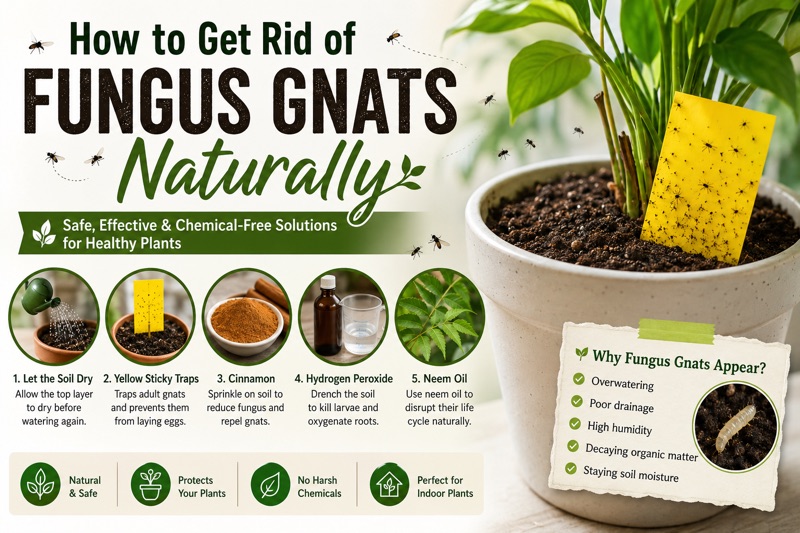
Safe, Effective, and Chemical-Free Solutions for Healthy Houseplants
Have you noticed tiny black flies hovering around your favorite houseplants? If so, you’re probably dealing with fungus gnats. While these insects may look similar to fruit flies, they have a very different lifestyle—and they can quickly become a frustrating problem for indoor gardeners.
The good news is that fungus gnats are usually more annoying than dangerous. Adult gnats rarely damage healthy plants directly, but their larvae live in moist potting soil and feed on fungi, decaying organic matter, and sometimes delicate roots. If left untreated, a large infestation can weaken young plants and slow their growth.
Fortunately, you don’t need harsh chemicals to solve the problem. With a few simple, natural methods and some patience, you can eliminate fungus gnats and keep your indoor plants healthy.
In this guide, you’ll learn what causes fungus gnats, how to identify them, the best natural treatments, and practical ways to prevent them from returning.
🐞 What Are Fungus Gnats?
Fungus gnats are tiny flying insects that thrive in damp potting soil. Adult gnats are usually black or dark gray with long legs and transparent wings, measuring only about 2–4 mm in length.
Although the adults are mostly harmless, their larvae live beneath the soil surface where they feed on fungi and organic matter. In severe infestations, they may also feed on young roots, especially in seedlings or recently propagated plants.
🔍 Signs You Have Fungus Gnats
Not sure if fungus gnats are the problem? Look for these common signs:
- 🪰 Tiny black flies flying around your plants.
- 🌱 Small insects crawling on the soil surface.
- 💧 The potting mix stays wet for long periods.
- 🌿 Slow or weak plant growth.
- 🥀 Seedlings suddenly collapse or fail to grow.
- 🔦 Adult gnats gathering near windows or indoor lights.
If you notice several of these signs, fungus gnats are likely the cause.
💧 Why Do Fungus Gnats Appear?
Understanding why fungus gnats appear is the first step toward eliminating them.
1. Overwatering
The most common cause is consistently wet soil. Fungus gnats love moist environments where fungi can grow.
🌿 Tip:
Allow the top 1–2 inches (2.5–5 cm) of soil to dry before watering again.
2. Poor Drainage
Even if you don’t water too often, pots without proper drainage can trap excess moisture.
🌿 Tip:
Always choose containers with drainage holes and use a well-draining potting mix.
3. Organic Matter in Soil
Decaying leaves, bark, and other organic materials provide food for fungi, which in turn attract fungus gnat larvae.
Remove dead leaves from the soil surface regularly to reduce their food source.
4. High Indoor Humidity
Warm, humid indoor environments encourage fungal growth and create perfect breeding conditions.
Improving airflow around your plants can help reduce humidity near the soil.
🌱 Are Fungus Gnats Harmful?
For mature, healthy houseplants, fungus gnats are mostly a nuisance.
However, they can become a problem when:
- 🌱 Growing seedlings.
- 🌿 Rooting cuttings.
- 🪴 Caring for newly repotted plants.
- 🌾 Maintaining delicate tropical species.
Large numbers of larvae feeding on tender roots may slow plant growth and increase stress.
🌿 Natural Method #1: Let the Soil Dry
One of the simplest and most effective natural treatments is allowing the soil to dry between waterings.
Since fungus gnat larvae require moisture to survive, reducing soil moisture interrupts their life cycle.
✅ How to Do It
- Wait until the top layer of soil feels dry.
- Water deeply but less frequently.
- Never leave standing water in saucers.
This single habit often reduces fungus gnat populations dramatically within a couple of weeks.
🟡 Natural Method #2: Use Yellow Sticky Traps
Yellow sticky traps are one of the easiest ways to capture adult fungus gnats.
The bright yellow color attracts flying adults, preventing them from laying more eggs in the soil.
✅ Best Practices
- Place one or two traps in each affected pot.
- Replace traps when they become full.
- Continue using them until no adult gnats are visible.
Sticky traps won’t kill larvae, but they are excellent for breaking the breeding cycle
🌿 Natural Method #3: Cinnamon Powder
Ground cinnamon is one of the most popular natural remedies for fungus gnats. While it doesn’t kill the insects directly, it helps reduce the fungi that larvae feed on.
✅ How to Use It
- Sprinkle a thin layer of ground cinnamon over the soil surface.
- Avoid applying thick layers, as they may form a crust after watering.
- Reapply after heavy watering if needed.
🌱 Why It Works
Cinnamon has natural antifungal properties that help limit fungal growth, making the soil less attractive to fungus gnat larvae.
🥔 Natural Method #4: Potato Slices
This simple trick helps you determine whether larvae are still living in the soil.
✅ How to Use It
- Cut a raw potato into thin slices.
- Place the slices directly on top of the soil.
- Leave them for 4–6 hours.
- Lift the slices and inspect the underside.
If you see tiny, translucent larvae feeding on the potato, fungus gnat larvae are still active in the pot.
🌿 Why It Works
Potatoes attract hungry larvae, making them easier to detect without disturbing the plant.
🌿 Natural Method #5: Hydrogen Peroxide Solution
Hydrogen peroxide can help eliminate larvae hiding in the soil while adding oxygen to the root zone.
⚠️ Use Carefully
Use only 3% hydrogen peroxide, which is commonly available in pharmacies.
✅ How to Prepare
- Mix 1 part 3% hydrogen peroxide with 4 parts water.
- Water the soil once using this solution.
- You may notice gentle bubbling—this is normal.
🌱 Benefits
- Helps reduce fungus gnat larvae.
- Oxygenates the soil.
- Breaks down into water and oxygen after use.
Avoid using this treatment too frequently. One application is often enough, with a second only if necessary after a week.
🌿 Natural Method #6: Neem Oil
Neem oil is one of the most trusted natural pest control solutions for indoor plants.
✅ How to Use It
- Mix according to the product instructions.
- Water the soil lightly or spray the soil surface.
- Repeat every 7–10 days until the infestation disappears.
🌱 Why Gardeners Love Neem Oil
- Natural pest control.
- Helps interrupt insect life cycles.
- Safe for most houseplants when used correctly.
🦠 Natural Method #7: Beneficial Nematodes
For severe infestations, beneficial nematodes are an excellent biological solution.
These microscopic organisms live naturally in soil and feed on fungus gnat larvae without harming your plants.
🌿 Benefits
- Completely natural.
- Targets larvae directly.
- Safe for pets and indoor plants.
- Long-lasting protection.
This method is especially useful for plant collections with recurring infestations.
💧 Improve Your Watering Routine
Since excess moisture is the main cause of fungus gnats, adjusting your watering habits is one of the best long-term solutions.
✅ Healthy Watering Tips
💧 Check the soil with your finger before watering.
🌱 Water deeply rather than frequently.
🪴 Empty drainage saucers after watering.
🌬️ Improve air circulation around your plants.
☀️ Place plants where they receive appropriate light so the soil dries at a healthy rate.
🚫 Common Mistakes to Avoid
Many plant owners accidentally make fungus gnat problems worse.
Avoid these common mistakes:
❌ Watering on a fixed schedule instead of checking the soil.
❌ Leaving dead leaves on top of the potting mix.
❌ Using pots without drainage holes.
❌ Ignoring the first few flying gnats.
❌ Treating only the adult insects while forgetting the larvae in the soil.
Remember: eliminating the larvae is the key to solving the problem permanently.
🌿 Prevention Tips
Once the fungus gnats are gone, a few simple habits can keep them from coming back.
🌱 Prevent Future Infestations
- Allow the top layer of soil to dry between waterings.
- Use high-quality, well-draining potting mix.
- Remove dead leaves promptly.
- Inspect new plants before bringing them indoors.
- Keep yellow sticky traps nearby as an early warning system.
- Clean pots and trays regularly.
Prevention is much easier than dealing with another infestation.
Frequently Asked Questions (FAQ)
🪰 How long does it take to get rid of fungus gnats naturally?
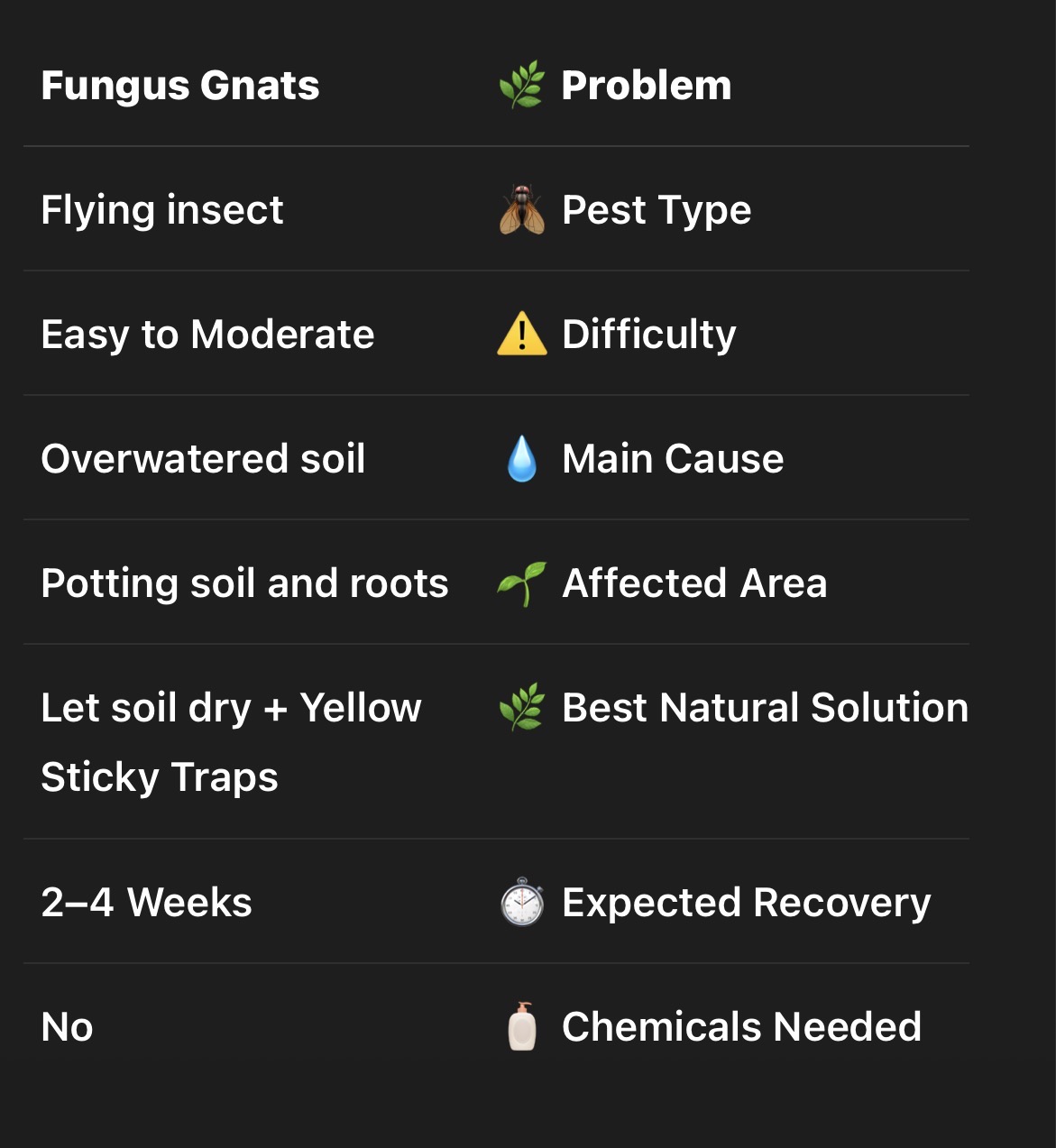
Most infestations improve within 2–4 weeks when you combine multiple methods, such as reducing watering, using yellow sticky traps, and treating the soil. Severe infestations may take a little longer, but consistency is the key to success.
🌱 Will fungus gnats kill my houseplants?
In most cases, no. Adult fungus gnats are mainly a nuisance. However, large numbers of larvae can damage delicate roots, especially in seedlings, cuttings, and young plants.
💧 Does overwatering always cause fungus gnats?
Overwatering is the most common cause, but poor drainage, consistently damp soil, and decaying organic matter can also create ideal breeding conditions.
🍃 Is neem oil safe for indoor plants?
Yes. When used according to the manufacturer’s instructions, neem oil is generally safe for most houseplants and is widely used as a natural pest-control solution.
🪴 Should I repot my plant?
Repotting is usually not necessary unless the soil is old, compacted, moldy, or the infestation is extremely severe. In many cases, adjusting your watering routine and treating the existing soil is enough.
❓ Frequently Asked Questions (FAQ)
🪰 How long does it take to get rid of fungus gnats naturally?
Most infestations improve within 2–4 weeks when you combine multiple methods, such as reducing watering, using yellow sticky traps, and treating the soil. Severe infestations may take a little longer, but consistency is the key to success.
🌱 Will fungus gnats kill my houseplants?
In most cases, no. Adult fungus gnats are mainly a nuisance. However, large numbers of larvae can damage delicate roots, especially in seedlings, cuttings, and young plants.
💧 Does overwatering always cause fungus gnats?
Overwatering is the most common cause, but poor drainage, consistently damp soil, and decaying organic matter can also create ideal breeding conditions.
🍃 Is neem oil safe for indoor plants?
Yes. When used according to the manufacturer’s instructions, neem oil is generally safe for most houseplants and is widely used as a natural pest-control solution.
🪴 Should I repot my plant?
Repotting is usually not necessary unless the soil is old, compacted, moldy, or the infestation is extremely severe. In many cases, adjusting your watering routine and treating the existing soil is enough.
📊 Quick Plant Problem Summary
💡 Pro Tips
✅ Water your plants only when they actually need it—not on a fixed schedule.
✅ A moisture meter can help prevent accidental overwatering.
✅ Always inspect new houseplants before placing them near your existing collection.
✅ Good airflow and proper drainage are just as important as watering.
✅ Solving the root cause is far more effective than simply catching adult gnats.
🌿 Final Thoughts
Fungus gnats may be one of the most common problems for indoor plant owners, but they are also one of the easiest to manage naturally.
By improving your watering habits, allowing the soil to dry between waterings, and using simple solutions like yellow sticky traps, cinnamon, neem oil, or beneficial nematodes, you can break the fungus gnat life cycle without relying on harsh chemicals.
Healthy plants begin with healthy soil. When you create the right growing environment, your houseplants become stronger, pests become less common, and caring for your indoor garden becomes much more enjoyable.
With patience and consistent care, your plants will soon be thriving again—free from fungus gnats.
Comments
Post a Comment