
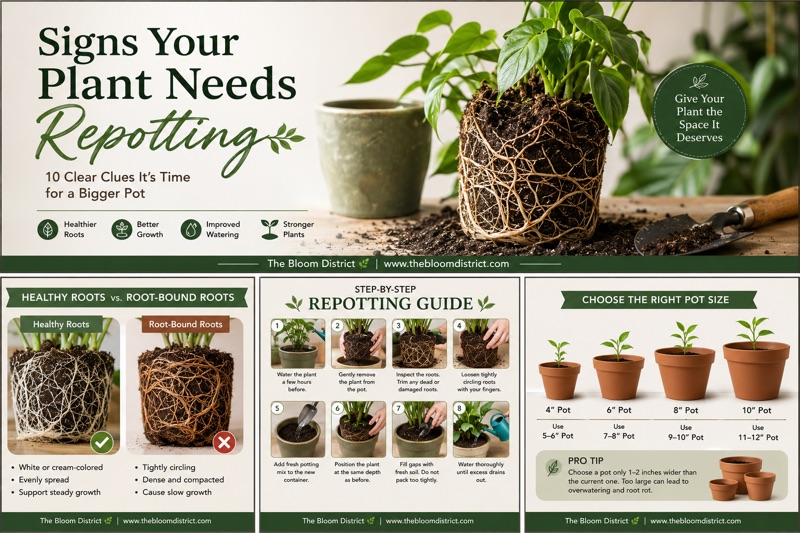
🌿 Is Your Plant Secretly Asking for a Bigger Home?
A thriving houseplant can brighten any room, purify the air, and bring a touch of nature indoors. But even the healthiest plant will eventually outgrow its pot.
Many plant owners mistake slow growth, yellow leaves, or constant wilting for watering problems. In reality, the issue may be much simpler—your plant has run out of room.
Repotting isn’t just about giving roots more space. It refreshes old soil, improves drainage, restores nutrients, and encourages vigorous new growth. Knowing when to repot can make the difference between a struggling plant and one that flourishes for years.
🌱 Quick Answer
If your plant’s roots are growing out of drainage holes, circling tightly inside the pot, drying out unusually fast, or showing slowed growth despite proper care, it’s likely time for repotting.
📋 Quick Diagnosis Table
|
Symptom |
Possible Cause |
Repot Needed? |
|
Roots growing through drainage holes |
Root-bound plant |
✅ Yes |
|
Water runs straight through soil |
Compact or exhausted soil |
✅ Usually |
|
Plant dries out every day |
Roots occupy most of the pot |
✅ Yes |
|
Slow or no new growth |
Root congestion |
✅ Often |
|
Pot tips over easily |
Plant has become top-heavy |
✅ Yes |
|
Yellow leaves despite proper care |
Restricted roots or poor soil |
✅ Possibly |
|
White crust on soil surface |
Salt buildup |
✅ Recommended |
|
Roots visible on soil surface |
Insufficient root space |
✅ Yes |
🌱 Why Repotting Is Important
Think of a plant’s pot as its home.
At first, there’s plenty of room for roots to spread, absorb water, and collect nutrients. Over time, however, roots continue growing until they fill every available space.
When that happens:
- Water drains too quickly.
- Soil holds fewer nutrients.
- Roots begin wrapping around each other.
- Oxygen circulation decreases.
- Plant growth slows dramatically.
Repotting restores a healthy environment where roots can breathe, expand, and support vigorous foliage.
🔍 10 Clear Signs Your Plant Needs Repotting
1. Roots Are Growing Out of the Drainage Holes
This is the easiest sign to spot.
When roots begin escaping through the bottom of the pot, they’ve exhausted every inch of available space.
What to do
Choose a new container only 1–2 inches (2.5–5 cm) wider than the current one.
💡 Pro Tip
Jumping to an oversized pot can leave excess soil wet for too long, increasing the risk of root rot.
2. Roots Circle Around the Inside of the Pot
If you gently remove the plant and see thick roots spiraling around the root ball, the plant has become root-bound.
A root-bound plant struggles to:
- Absorb nutrients efficiently.
- Store enough moisture.
- Produce healthy new roots.
The sooner it’s repotted, the easier recovery will be.
3. Water Runs Straight Through the Pot
Have you noticed water pouring out almost immediately after watering?
This often means roots have replaced much of the soil.
Instead of soaking into the growing medium, water slips through empty gaps created by tangled roots.
Signs this is happening
✔ Soil doesn’t absorb moisture.
✔ Water drains within seconds.
✔ Plant still looks thirsty afterward.
4. The Soil Dries Out Extremely Fast
Does your plant need watering every day when it previously lasted a week?
Dense roots leave little room for moisture retention.
If you’re watering far more frequently than before—and environmental conditions haven’t changed—the pot may simply be too small.
5. Growth Has Stopped
Healthy plants naturally slow during winter.
However, if it’s the active growing season and your plant hasn’t produced:
- New leaves
- New stems
- Fresh shoots
for several months, restricted roots may be preventing further development.
6. Yellow Leaves Keep Appearing
Yellow leaves don’t always indicate overwatering.
A crowded root system struggles to absorb essential nutrients like nitrogen, magnesium, and iron.
If watering and lighting are correct but leaves continue yellowing, inspect the roots before assuming disease.
🌼 Did You Know?
A severely root-bound plant can develop nutrient deficiencies even when the soil contains enough fertilizer because crowded roots cannot absorb nutrients efficiently.
7. Roots Are Visible Above the Soil
Some roots naturally appear near the surface.
However, when large roots push upward because there’s nowhere else to grow, the plant is signaling that it has completely filled its container.
8. The Plant Falls Over Easily
Tall houseplants such as:
- Monstera
- Bird of Paradise
- Rubber Plant
- Fiddle Leaf Fig
can become unstable once their foliage outweighs the small pot.
A heavier, slightly larger container provides better balance and improved root support.
9. White Crust Appears on the Soil Surface
A white layer often forms from accumulated fertilizer salts and minerals.
Although not always harmful, it usually indicates the potting mix is aging.
Repotting replaces tired soil with fresh, nutrient-rich growing medium.
10. Your Plant Has Been in the Same Pot for Years
Even if your plant appears healthy, potting soil gradually breaks down.
Most houseplants benefit from fresh soil every:
|
Plant Type |
Repot Every |
|
Fast-growing tropical plants |
1- 2 years |
|
Pothos |
1- 2 years |
|
Monstera |
1-2 years |
|
Spider Plant |
1-2 years |
|
Peace Lily |
1-2 years |
|
Snake Plant |
2-3 years |
|
ZZ Plant |
2-3 years |
|
Succulents |
2-4 years |
|
Orchids |
1-2 years |
🚫 When NOT to Repot
Repotting at the wrong time can stress your plant unnecessarily.
Avoid repotting when:
- The plant is flowering heavily.
- It’s dormant during winter.
- The plant has recently been moved.
- It has just recovered from disease.
- It was purchased only a few days ago (allow time to acclimate).
🌸 Best Time to Repot Plants
The ideal period is:
✅ Early spring
✅ Mid spring
✅ Early summer
This is when plants naturally produce new roots and recover quickly from transplant shock.
🪴 Choosing the Right Pot
|
Current Pot |
New Pot Size |
|
4 inches |
5-6 inches |
|
6 inches |
7-8 inches |
|
8 inches |
9-10 inches |
|
10 inches |
11-12 inches |
Always choose a container with drainage holes.
Avoid dramatically increasing pot size.
🛠 Step-by-Step Repotting Guide
Step 1
Water the plant a few hours beforehand.
Step 2
Carefully remove it from the pot.
Step 3
Inspect the roots.
Healthy roots should appear:
- White
- Cream-colored
- Firm
Trim away any black, mushy, or foul-smelling roots with sterilized scissors.
Step 4
Loosen tightly circling roots using your fingers.
Step 5
Add fresh potting mix to the new container.
Step 6
Position the plant at the same depth as before.
Step 7
Fill gaps with fresh soil.
Do not pack the soil too tightly.
Step 8
Water thoroughly until excess water drains from the bottom.
⚠️ Common Repotting Mistakes
❌ Choosing a pot that’s far too large.
❌ Using garden soil indoors.
❌ Forgetting drainage holes.
❌ Compacting the soil excessively.
❌ Fertilizing immediately after repotting.
❌ Repotting during winter dormancy.
🌿 Aftercare Tips
For the first two weeks:
- Keep the plant in bright, indirect light.
- Avoid heavy fertilizing.
- Water only when the top inch of soil feels dry.
- Watch for new growth, which indicates successful establishment.
🌼 Recovery Tip
Mild drooping after repotting is normal. Most healthy plants recover within a week or two as their roots settle into fresh soil.
📊 Healthy Roots vs. Root-Bound Roots
|
Healthy Roots |
Root-Bound Roots |
|
White or cream-colored |
Tightly circling |
|
Evenly spread through soil |
Dense tangled mass |
|
Moist but well-aerated |
Little soil visible |
|
Flexible |
Compact and restricted |
|
Support steady growth |
Cause slow growth |
❓Frequently Asked Questions
How often should I repot indoor plants?
Most indoor plants benefit from repotting every 1–2 years, though slow-growing species may only need it every 2–4 years.
Can I repot a plant into a much larger pot?
It’s not recommended. Oversized pots retain excess moisture, which can increase the risk of root rot.
Should I fertilize immediately after repotting?
No. Fresh potting mix already contains nutrients. Wait about 3–4 weeks before applying fertilizer.
Can repotting save a dying plant?
If root restriction or depleted soil is the main issue, repotting can significantly improve the plant’s health. However, plants suffering from severe disease or root rot may require additional treatment.
Is it normal for a plant to droop after repotting?
Yes. Temporary transplant shock is common. With proper watering and light, most healthy plants recover within a couple of weeks.
🌿 Final Thoughts
Your plant rarely tells you it needs a bigger pot with words—but it does send clear signals. Roots escaping through drainage holes, rapid soil drying, stalled growth, and visible root congestion are all signs that it’s time for a new home.
By repotting at the right time, choosing an appropriately sized container, and using fresh, well-draining soil, you’ll give your plant the space and resources it needs to thrive. A little attention today can reward you with healthier roots, lush foliage, and stronger growth for seasons to come.
Related Articles
Comments
Post a Comment