
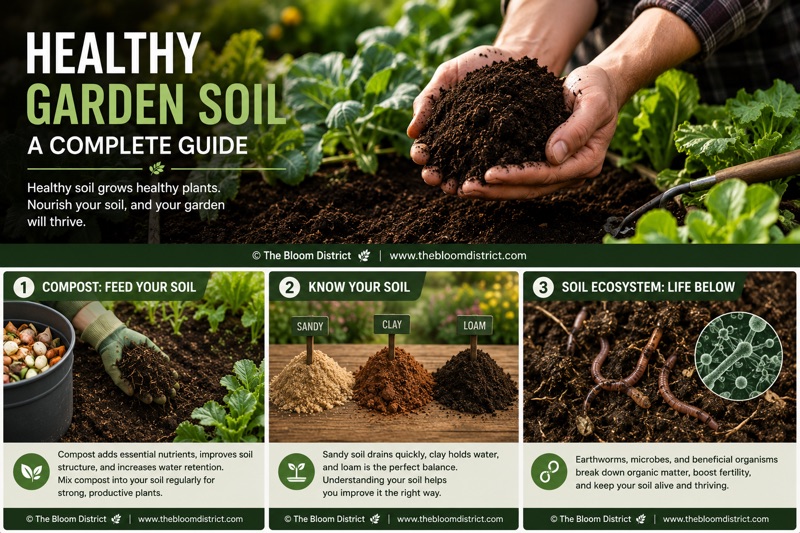
The Secret Beneath Every Beautiful Garden
Walk through any flourishing garden and you will notice the colorful flowers, healthy leaves, and abundant harvests. But the real magic happens where your eyes cannot see — beneath the surface.
Healthy soil is the hidden engine behind every strong plant.
Many gardeners spend hours choosing the perfect seeds, buying fertilizers, and searching for the best plants, but they often forget the most important question:
“Is my soil healthy enough to support life?”
Great gardens do not start with plants. They start with the soil.
In this guide, you will discover how to transform poor garden soil into a rich, living environment where roots can grow stronger, plants can resist diseases, and your garden can thrive naturally.
🌿 Quick Soil Health Checklist
|
|
|
|
Color |
Dark brown or almost black |
|
Texture |
Loose, crumbly, and easy to work with |
|
Drainage |
Holds moisture but does not stay soggy |
|
Smell |
Fresh earthy smell |
|
Life |
Contains worms and microorganisms |
Why Healthy Soil Matters for Your Garden
Soil is more than dirt. It is a living ecosystem filled with:
🌱 Organic matter
🪱 Earthworms
🦠 Beneficial microorganisms
💧 Water channels
🌿 Essential nutrients
Healthy soil helps plants:
- Develop stronger root systems
- Absorb nutrients efficiently
- Handle drought and heat better
- Produce more flowers and vegetables
- Resist common plant problems
Poor soil, on the other hand, can lead to:
- Yellowing leaves
- Slow growth
- Weak roots
- Water problems
- Increased pests and diseases
Step 1: Test Your Garden Soil First
Before adding anything to your soil, understand what you already have.
A simple soil test can reveal:
- pH level
- Nutrient deficiencies
- Soil type
- Organic matter levels
Understanding Soil pH
|
Soil Type |
pH Range |
Suitable Plants |
|
Acidic Soil |
Below 6 |
Blueberries, azaleas |
|
Neutral Soil |
Around 7 |
Most vegetables and flowers |
|
Alkaline Soil |
Above 7 |
Lavender, some Mediterranean plants |
Most garden plants prefer slightly acidic to neutral soil.
Step 2: Add Organic Matter — The Soil Improvement Secret
The fastest way to improve garden soil is adding organic matter.
Organic matter improves:
✅ Soil structure
✅ Water retention
✅ Nutrient availability
✅ Microbial activity
The best options include:
Compost
Compost is often called “black gold” by gardeners.
It adds nutrients slowly and improves almost every type of soil.
Aged Manure
Well-aged manure can increase fertility, but avoid using fresh manure because it may damage plant roots.
Leaf Mold
Decomposed leaves create a natural soil conditioner that improves moisture retention.
Kitchen Compost
Fruit scraps, vegetable waste, and coffee grounds can become valuable nutrients when properly composted.
🌱 Soil Improvement Comparison Table
|
Amendment |
Best For |
Main Benefit |
|
Compost |
Almost all gardens |
Adds nutrients and improves structure |
|
Mulch |
Dry gardens |
Protects moisture |
|
Sand |
Heavy clay soil |
Improves drainage |
|
Clay minerals |
Sandy soil |
Helps retain nutrients |
|
Leaf mold |
Flower beds |
Improves texture |
Step 3: Understand Your Soil Type
Every garden has different soil challenges.
Sandy Soil
Signs:
- Feels gritty
- Drains quickly
- Plants dry out easily
Solution:
Add:
🌿 Compost
🌿 Aged manure
🌿 Organic mulch
Clay Soil
Signs:
- Sticky when wet
- Hard when dry
- Poor drainage
Solution:
Add:
🌿 Compost
🌿 Leaf mold
🌿 Organic materials
Avoid adding only sand because it can create a harder soil texture.
Loamy Soil
This is considered the ideal garden soil.
It has:
- Good drainage
- Good moisture retention
- Balanced nutrients
The goal of many gardeners is creating soil that behaves like loam.
Step 4: Feed Your Soil, Not Just Your Plants
Many beginners focus only on fertilizers.
But fertilizers feed plants temporarily.
Healthy soil creates a natural food system.
Instead of asking:
❌ “What fertilizer should I buy?”
Ask:
✅ “How can I improve my soil ecosystem?”
Healthy soil organisms naturally break down organic materials and release nutrients for plants.
Step 5: Use Mulch to Protect Your Soil
Mulch acts like a protective blanket for your garden.
Benefits:
🌿 Reduces evaporation
🌿 Controls weeds
🌿 Protects roots from temperature changes
🌿 Adds organic matter over time
Good mulch options:
- Shredded leaves
- Wood chips
- Straw
- Compost
Apply a layer of mulch around plants, but avoid piling it directly against stems.
Step 6: Encourage Soil Life
A healthy garden is full of invisible activity.
Beneficial organisms help:
- Break down organic materials
- Improve nutrient cycling
- Create better soil structure
Ways to support soil life:
🪱 Avoid excessive digging
🌱 Add compost regularly
🍂 Leave some organic material on the soil
🚫 Avoid unnecessary chemical treatments
Common Soil Problems and Solutions
|
Problem |
Symptoms |
Solution |
|
Compacted soil |
Roots struggle, water runs off |
Add compost and reduce foot traffic |
|
Poor drainage |
Yellow leaves, root problems |
Improve soil structure |
|
Low nutrients |
Weak growth |
Add organic compost |
|
Dry soil |
Plants wilt quickly |
Use mulch and organic matter |
|
Too much clay |
Hard soil |
Add compost regularly |
Seasonal Soil Care Guide
Spring 🌸
- Add compost before planting
- Prepare garden beds
- Test soil if needed
Summer ☀️
- Maintain mulch layers
- Protect moisture
- Avoid disturbing roots
Fall 🍂
- Add fallen leaves
- Create compost
- Prepare soil for next season
Winter ❄️
- Protect exposed soil
- Avoid unnecessary digging
Natural Ways to Improve Garden Soil
1. Grow Cover Crops
Plants like clover and legumes can improve soil naturally.
2. Add Worm Compost
Worm castings provide gentle nutrients and beneficial microorganisms.
3. Rotate Crops
Changing planting locations helps prevent nutrient depletion.
4. Keep Soil Covered
Bare soil loses moisture and life quickly.
Beginner Mistakes That Damage Soil
❌ Adding fertilizer without testing soil
❌ Digging too frequently
❌ Leaving soil uncovered
❌ Using fresh manure
❌ Removing all fallen leaves
❌ Ignoring drainage problems
🌿 The Bloom District Garden Tip
Healthy soil is not created overnight.
Think of your garden soil like a living relationship — the more care you give it, the more it gives back.
A handful of rich soil contains millions of tiny organisms working together to support your plants.
Build the soil first, and the garden will follow.
Frequently Asked Questions (FAQ)
How long does it take to improve garden soil?
Small improvements can appear within a few months, but creating excellent soil quality usually requires ongoing care over several seasons.
Can I improve soil without chemicals?
Yes. Compost, mulch, organic matter, and natural soil-building methods can greatly improve garden soil.
How often should I add compost?
Most gardens benefit from adding compost once or twice per year.
What is the best soil for vegetables?
Vegetables usually grow best in rich, loose, well-draining loamy soil with plenty of organic matter.
Should I remove old mulch every year?
Not always. Organic mulch naturally breaks down and becomes part of the soil.
Related Articles
Comments
Post a Comment