
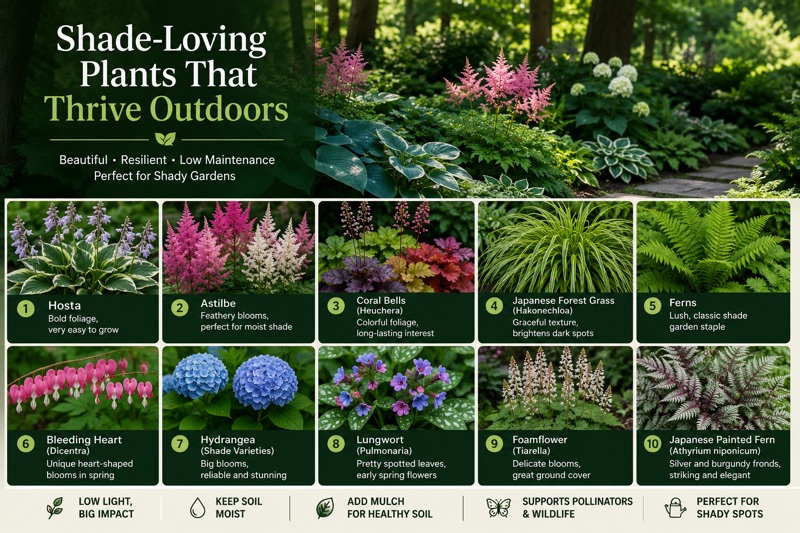
The Best Outdoor Plants That Flourish in Low-Light Gardens
Many gardeners assume that every beautiful plant needs full sunlight to grow successfully. Fortunately, that’s far from the truth.
In nature, countless plants thrive beneath forest canopies where direct sunlight rarely reaches the ground. These shade-loving species have adapted to lower light levels while producing lush foliage, colorful flowers, and attractive textures that can completely transform darker areas of your landscape.
Whether you’re planting beneath mature trees, along the north side of your house, or in a shaded backyard corner, choosing the right plants allows you to create a vibrant and healthy garden without fighting nature.
This guide introduces some of the best outdoor plants that flourish in shade, along with practical care tips to help them thrive year after year.
Shade?
A shaded garden offers its own unique beauty. Instead of viewing low-light areas as a challenge, consider them an opportunity to grow plants that simply wouldn’t perform well in intense afternoon sun.
🌿 Benefits of Shade Gardens
✅ Lower water evaporation from soil
✅ Reduced heat stress during summer
✅ Rich green foliage throughout the season
✅ Cooler, more relaxing outdoor spaces
✅ Excellent habitat for birds, butterflies, and beneficial insects
With thoughtful plant selection, shaded areas can become some of the most attractive parts of your landscape.
☀️ Understanding Different Types of Shade
Not all shade is the same. Knowing how much light your garden receives helps you choose plants that will perform their best.
🌤️ Partial Shade
Receives approximately 3–6 hours of sunlight each day, usually during the morning.
Ideal for many flowering shade plants.
🌥️ Dappled Shade
Sunlight filters through tree branches, creating moving patches of light throughout the day.
This closely resembles a natural woodland environment.
🌑 Full Shade
Receives little or no direct sunlight but still benefits from indirect daylight.
Many foliage plants thrive under these conditions.
🌿 1. Hosta
🌟 Overview
Hostas are among the most popular shade-loving perennials in the world. They are admired for their large, textured leaves that come in shades of green, blue, gold, and creamy white.
Rather than relying on flowers, Hostas create visual interest through their impressive foliage, making them ideal for borders, pathways, and shaded beds.
☀️ Light Requirements
Partial shade to full shade.
💧 Water Needs
Keep the soil evenly moist, especially during hot weather.
🌱 Why Gardeners Love Hostas
- Beautiful foliage all season.
- Extremely beginner-friendly.
- Available in hundreds of varieties.
- Excellent for filling empty spaces beneath trees.
🌸 2. Astilbe
🌟 Overview
Astilbe produces elegant, feathery flower plumes that bloom in shades of pink, white, red, and lavender.
Its flowers add height and softness to shaded gardens while attracting bees and butterflies.
☀️ Light Requirements
Partial shade.
💧 Water Needs
Requires consistently moist soil.
🌱 Highlights
- Long-lasting summer blooms.
- Excellent companion plant for Hostas.
- Deer and rabbit resistant in many areas.
🌿 3. Coral Bells (Heuchera)
🌟 Overview
Coral Bells are famous for their colorful foliage, which ranges from deep purple and burgundy to bright lime green and silver.
Their delicate flower spikes appear in late spring and early summer, adding another layer of beauty.
☀️ Light Requirements
Partial shade.
💧 Water Needs
Moderate watering with well-drained soil.
🌱 Why Choose Coral Bells?
- Stunning foliage year-round.
- Compact growth.
- Ideal for borders and containers.
- Attractive to pollinators.
🌿 4. Japanese Forest Grass
🌟 Overview
Japanese Forest Grass brings graceful movement to shaded gardens with its arching, ribbon-like leaves.
Its golden or green foliage brightens darker spaces and pairs beautifully with Hostas and ferns.
☀️ Light Requirements
Partial to full shade.
💧 Water Needs
Moderate; prefers consistently moist soil.
🌱 Best Features
- Elegant cascading habit.
- Brightens shaded corners.
- Low-maintenance once established.
🌿 5. Ferns
🌟 Overview
Ferns have been growing in forests for millions of years, making them one of nature’s most reliable shade-loving plants. Their delicate, feathery fronds create a lush woodland appearance that instantly makes a garden feel cooler and more peaceful.
There are many varieties available, allowing gardeners to choose the perfect size and texture for their landscape.
☀️ Light Requirements
Partial shade to full shade.
💧 Water Needs
Keep the soil consistently moist but never waterlogged.
🌱 Why You’ll Love Ferns
- Thrive in deep shade.
- Elegant, tropical appearance.
- Perfect under large trees.
- Excellent companion for Hostas and Astilbe
6. Bleeding Heart
🌟 Overview
Bleeding Heart is famous for its unique heart-shaped flowers that gracefully hang from arching stems during spring.
Its romantic appearance makes it one of the most beautiful flowering plants for shady gardens.
☀️ Light Requirements
Morning sun or partial shade.
💧 Water Needs
Moist, well-drained soil.
🌱 Highlights
- Unique heart-shaped blooms.
- Excellent woodland plant.
- Blooms in early spring.
- Adds elegance to shaded borders.
🌸 7. Hydrangea
🌟 Overview
Many Hydrangea varieties perform exceptionally well in partial shade, producing large, colorful flower clusters throughout summer.
Their impressive blooms can become the centerpiece of almost any garden.
☀️ Light Requirements
Morning sun with afternoon shade.
💧 Water Needs
Moderate to high, especially during hot weather.
🌱 Why Gardeners Choose Hydrangeas
- Large, eye-catching flowers.
- Long blooming season.
- Available in blue, pink, white, and purple varieties.
- Excellent for foundation plantings.
8. Lungwort (Pulmonaria)
🌟 Overview
Despite its unusual name, Lungwort is an attractive perennial known for its spotted leaves and charming spring flowers.
Its foliage remains decorative even after flowering ends.
☀️ Light Requirements
Partial to full shade.
💧 Water Needs
Moderately moist soil.
🌱 Benefits
- Beautiful silver-patterned leaves.
- Early spring flowers.
- Pollinator-friendly.
- Excellent ground cover.
9. Foamflower (Tiarella)
🌟 Overview
Foamflower is a compact woodland perennial that produces delicate spikes of creamy white flowers above attractive green foliage. It spreads slowly, creating a beautiful natural carpet beneath trees
☀️ Light Requirements
Partial shade.
💧 Water Needs
Keep soil evenly moist.
🌱 Why It’s Worth Growing
- Soft, elegant flowers.
- Excellent ground cover.
- Native to North American woodlands.
- Easy to maintain.
🌿 10. Japanese Painted Fern
🌟 Overview
This award-winning fern stands out thanks to its stunning silver, green, and burgundy foliage.
It adds texture and contrast to shaded gardens where colorful foliage is often more valuable than flowers.
☀️ Light Requirements
Full shade to partial shade.
💧 Water Needs
Moderate watering with consistently moist soil.
🌱 Best Features
- Beautiful metallic foliage.
- Cold hardy.
- Perfect for woodland gardens.
- Low-maintenance.
🌱 Tips for Growing Healthy Shade Plants
Even shade-loving plants need the right care to perform their best.
🌿 Improve the Soil
Enrich the soil with compost each spring to improve drainage while retaining moisture.
💧 Water Deeply
Although shade reduces evaporation, plants still need regular watering during dry periods.
Aim to water deeply rather than frequently.
🍂 Mulch Around Plants
Apply a 2–3 inch layer of organic mulch to:
- Retain soil moisture.
- Suppress weeds.
- Regulate soil temperature.
- Improve soil over time.
🌬️ Improve Air Circulation
Avoid overcrowding plants.
Good airflow reduces fungal diseases and keeps foliage healthier.
✂️ Remove Dead Leaves
Prune damaged foliage regularly to encourage fresh growth and maintain an attractive appearance.
⚠️ Common Mistakes to Avoid
Many gardeners accidentally create problems in shade gardens.
Avoid these mistakes:
❌ Choosing full-sun plants for shady areas.
❌ Watering too frequently.
❌ Ignoring soil drainage.
❌ Planting too closely together.
❌ Forgetting to add compost.
❌ Expecting rapid growth in deep shade.
Remember, healthy shade gardens rely on choosing the right plants rather than trying to change the environment.
💡 Pro Tips for a Thriving Shade Garden
Want your shade garden to look lush and healthy all season? Follow these expert tips:
✅ Group plants with similar water needs together to make watering easier.
✅ Add organic compost every spring to improve soil fertility and structure.
✅ Choose plants with different leaf colors and textures to create visual interest, even when flowers are not in bloom.
✅ Use mulch around plants to conserve moisture and suppress weeds.
✅ Clean up fallen leaves and dead plant material to reduce the risk of fungal diseases.
A successful shade garden is built on healthy soil, proper plant spacing, and consistent care—not on sunlight alone.
🌿 Quick Recommendations
❓ Frequently Asked Questions (FAQ)
🌿 Can plants really grow in full shade?
Yes. Many woodland plants naturally thrive in full shade because they have adapted to receive filtered or indirect light beneath tree canopies.
☀️ Which shade-loving plant is easiest for beginners?
Hostas are one of the easiest choices. They are hardy, forgiving, and available in many sizes and colors, making them perfect for beginner gardeners.
🌸 Do shade plants produce flowers?
Absolutely. Many shade-loving plants bloom beautifully, including Astilbe, Bleeding Heart, Foamflower, and certain Hydrangea varieties.
💧 Do shade plants need less water?
Not always. While shady areas lose moisture more slowly than sunny gardens, many shade-loving plants prefer consistently moist soil, especially during warm weather.
🪴 Can I grow shade-loving plants in containers?
Yes. Plants like Coral Bells, Ferns, Japanese Forest Grass, and Hostas grow very well in containers as long as they have proper drainage and are watered regularly.
📊 Quick Plant Summary
|
Plant |
Light |
Water |
Difficulty |
|
Hosta |
Partial to Full Shade |
Moderate |
Easy ⭐️ |
|
Astilbe |
Partial Shade |
Moderate |
Easy ⭐️⭐️ |
|
Coral Bells |
Partial Shade |
Moderate |
Easy ⭐️ |
|
Japanese Forest Grass |
Partial to Full Shade |
Moderate |
Easy ⭐️ |
|
Ferns |
Partial to Full Shade |
Moderate |
Easy ⭐️ |
|
Bleeding Heart |
Partial Shade |
Moderate |
Easy ⭐️⭐️ |
|
Hydrangea |
Morning Sun / Afternoon Shade |
Moderate |
Easy ⭐️⭐️ |
|
Lungwort |
Partial to Full Shade |
Moderate |
Easy ⭐️ |
|
Foamflower |
Partial Shade |
Moderate | Easy ⭐️ |
|
Japanese Painted Fern |
Partial to Full Shade |
Moderate |
Easy ⭐️ |
🌸 Final Thoughts
A shaded garden is not a limitation—it’s an opportunity to create a peaceful, elegant landscape filled with rich textures and vibrant foliage. By selecting plants that naturally thrive in low-light conditions, you can enjoy a beautiful outdoor space without struggling against the environment.
Whether you prefer the bold foliage of Hostas, the graceful blooms of Astilbe, or the delicate beauty of Japanese Painted Ferns, these shade-loving plants prove that sunshine isn’t the only path to a thriving garden.
Start with a few varieties, observe how they adapt to your space, and gradually build a layered shade garden that offers beauty throughout the seasons.
Comments
Post a Comment